Non-Invasive Brain-to-Speech. No surgery. No movement.
The first non-surgical, no-movement system that reaches fully locked-in patients.
The next interface between human and machine is thought. Natural. Not operated. Not spoken to. Not typed at. A computer the brain accepts as part of itself — the way it accepts a limb — where it speaks and the computer speaks back. That is what we are building.
This is Phase One. We start where the need is most urgent — 70 million people who cannot speak. Not because they have nothing to say. Because nothing can hear them yet.
"God has commanded us to advance." — The sentence that started this.
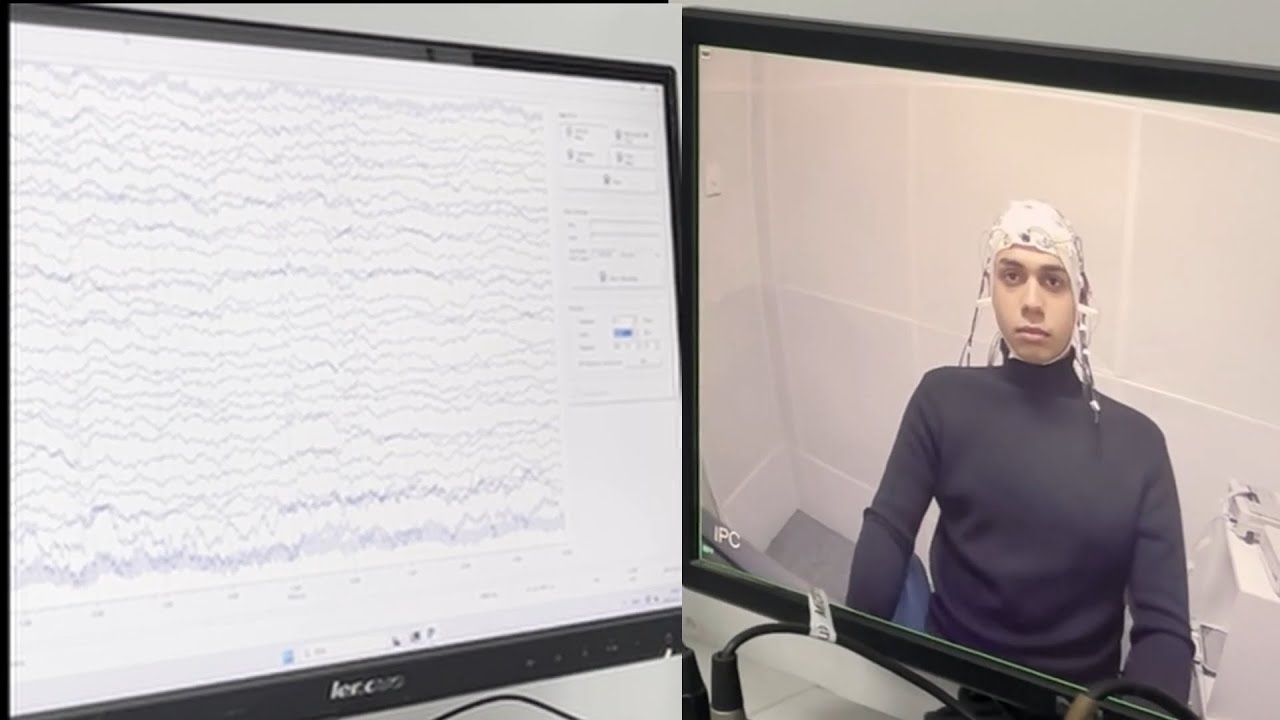
Real EEG signal. Real imagined sentences. The system is running on actual brain data — not synthetically generated, not reconstructed from text. Imagined speech neural activity patterns, decoded by the model.
Dataset: ChiSCO — the only large-scale published sentence-level imagined speech dataset · 23,000 recordings · Scientific Data, Nature 2024
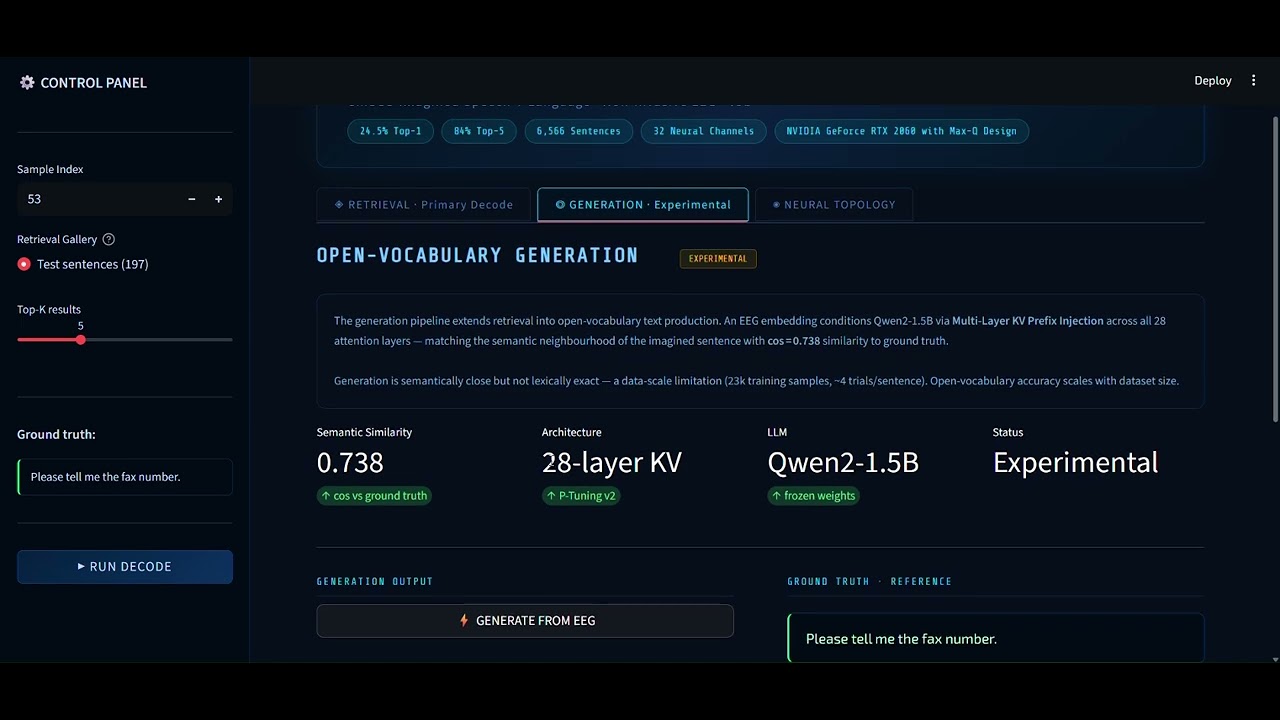
The system decoded what they were thinking. 84% of the time, in the top 5 guesses. 24.5% exact match. From imagined sentences. No speaking. No movement. No benchmark existed for this task — in research or industry — before we built one.
84% on 197 sentences is not a research result awaiting productization. AAC research shows 100–200 core phrases cover 80% of daily communication needs. Our 197-sentence corpus was not chosen arbitrarily — it is aligned with thirty years of AAC research. The number is not a research constraint. It is the right number for the first product. The right vocabulary, reliably decoded — gives a fully locked-in patient the ability to communicate pain, need, love, goodbye. That product does not exist today without surgery. It exists now. And as the system learns each individual's EEG patterns over time, Top-5 becomes Top-1 for that person. The first guess is right. Every time.
Billions of dollars. Brilliant engineers. Brain-computer interfaces that changed lives. And yet — the fully locked-in were never reached.
| Modality | Latency | Consumer Hardware | Natural Communication | Product Today |
|---|---|---|---|---|
| fNIRS | 5–6s biological delay | Language-capable fNIRS requires 388-channel whole-head system ($150,000–$350,000). Consumer EEG for language decoding: ~$1,900. | No — 5–6s hemodynamic delay (biological, not engineering) | MindPortal/MindSpeech (professional high-density fNIRS) |
| MEG | Milliseconds | No — room-sized | No — not wearable | Brain2Qwerty (Meta, research) |
| fMRI | Seconds | No — hospital only | No | None |
| EEG ✓ | Milliseconds | Yes — Emotiv, OpenBCI | Yes — millisecond-latency signal | Excelleve |
EEG is the only non-invasive modality with millisecond latency, language-capable consumer hardware, and no biological ceiling. Consumer fNIRS exists but is limited to prefrontal focus monitoring (1–4 channels) — language decoding requires high-density professional systems. EEG's historical limitations — noise and poor spatial resolution — have been solved at the methodology level. The hardware is unchanged. The results are new.
Transformers have existed for years. Consumer EEG hardware has existed for years. The window is not that these tools arrived — it is that we are the first to combine them correctly. ChiSCO published in Nature 2024 gave the first sentence-level imagined speech EEG dataset at scale. We applied Topological Data Analysis — a method that extracts structure from EEG noise that standard signal processing cannot reach. We built a neural-language architecture that works with the signal quality TDA produces — and it is language-agnostic by design. Remove any one element and the result does not exist. The window is what we built with what was available.
Meta AI published Brain2Qwerty — an EEG/MEG system that decodes imagined typing. The user mentally simulates typing on a keyboard while the system reads the associated brain signals. Built by a full research team with institutional resources. Their paper states explicitly: "It is not applicable to locked-in individuals, who are completely unable to perform a typing task."
Their stated next step: "adapting the typing task into an imagination task." That is what Excelleve has already done.
"God has commanded us to advance. There is a solution for everything in this world except death."
My father, when I asked him as a child if we could cure those who cannot speakI was a child when I asked it. He said — we don't have the answer yet, but in the future we will. If you pursue it, you can find it too. I never forgot that. At 13, I was researching dark matter and the theory of everything. The curiosity was not a phase. It was a direction.
At 17, in A-levels, I learned linear regression — the first building block of machine learning. A line that fits data. I sat with that idea and felt something open: with this one concept, I have a solution to every problem. Every phenomenon in nature produces data. We just need the right function. That week, I found a TED talk by Conor Russomanno, co-founder of OpenBCI — EEG signals on a screen, controlling things. I had never heard the words brain-computer interface. Within an hour, two ideas that had been waiting to meet finally did: my father's answer, and linear regression.
During my time at NYU Shanghai, six months changed everything. The obsession that had been building since I was 13 was no longer containable in a classroom. I took Andrew Ng's Deep Learning courses. He didn't teach AI as calculus or statistics — he taught it as an art. Something that, when you truly befriend it, opens completely to you. BCI became that art for me. The mathematics stopped being obstacles and became intuitions.
I took academic leave. Came back to Lahore. No lab. No team. No funding. Personal hardware. One public dataset — ChiSCO, the only one in existence — and compute constraints so tight I could not use all of it. Six months later, these are the results. That is the context for every number on this page. A-levels lit the spark. Shanghai deepened it. Lahore is where it became real.
"If this is what six months looks like with these constraints — what happens next?"
— Muhammad Huzyafa Khokhar, Founder & CEO, Excelleve · Started at 17 · Deepened in Shanghai · Built in LahoreEEG has real limitations — noise and poor spatial resolution are genuine, well-documented constraints. The hardware has not changed. What changed is how we process the signal. Modern ML pointed toward structure in the noise. Topological Data Analysis went further — finding what persists through noise without being told where to look. The result: noise minimized to a degree that makes sentence-level decoding possible. Spatial resolution solved specifically for the language task — the Broca-Wernicke circuit localized, the right hemisphere tonal processing regions identified (specific to Mandarin as a tonal language; the Broca-Wernicke circuit is universal and will be present in English data), without any linguistic prior. We did not prove EEG's limits wrong. We solved them for our task. That is what matters.
No prior EEG benchmark existed at sentence scale. We created one. Every result below was produced in six months, on personal compute, using one public open-source dataset — ChiSCO — under compute constraints that prevented using all available data. Every number is real, reproducible, and holds across 4 subjects — not a single-subject result.
+53% over DeWave (NeurIPS 2023) — on a task going deeper — purely imagined speech, no physical action whatsoever. DeWave used visual reading with eye-tracking assistance. We decoded purely imagined speech with no visual stimulus and no movement.
This is the first EEG system to decode purely imagined speech naturally — at sentence scale, no screen, no visual stimulus, no movement. The field has been underestimating EEG for language. ChiSCO confirmed semantic signal exists in EEG. We scaled that to sentence level — a fundamentally deeper task — and built a system that decodes it at clinically useful accuracy.
Note on open vocabulary: MindPortal (MindSpeech) reports 30% accuracy on a word-cloud prompted task using fNIRS. Our closed-sentence approach at 84% restores 80% of daily communication for locked-in patients today. True open vocabulary at useful accuracy is our 12-month target — the clinical deployments fund the data.
The fundamental question — can EEG decode imagined speech at a useful level — is answered. 84% Top-5 is the starting accuracy for every new user. As the system calibrates to an individual — their specific EEG signatures, their patterns — Top-5 becomes Top-1 for that person. That is the product arc: start useful, become precise. More data across more subjects scales this to everyone. That is what this round funds.
Noise and poor spatial resolution are real EEG constraints — the hardware is unchanged. But constraints in physics are not the same as constraints in methodology. A decade of BCI research told us which approaches failed and why. We came in last and built first.
Six advantages. Each one defensible on its own. Together, they form a position that compounds with every deployment.
What comes after EEG has a precise technical name: a closed-loop neural interface. A system that reads from the brain and writes back to it — simultaneously, continuously, in a feedback loop that never stops. EEG decoding is Phase One of building toward this. This is not speculative — closed-loop neural interfaces exist in clinical literature. What does not exist yet is one that works non-invasively, at the cognitive level, for natural language. That is the specific gap this company is building toward.
Every current BCI is open-loop — it reads from the brain and stops there. A closed-loop interface reads and writes simultaneously. But the critical distinction is which side does the learning. In a true closed-loop system, the interface continuously adapts to your neural patterns — learning your specific signal, your timing, your language circuit in real time. The brain does not need to learn new behaviors or control patterns. The interface does the learning — continuously adapting to your neural signal in real time, updating its model of your specific patterns until communication becomes effortless. Not because you adapted to the machine. Because the machine became fluent in you.
Closed-loop neural interfaces are well-established in research. Deep brain stimulation with adaptive feedback is a deployed clinical example — the stimulator reads brain state and adjusts its output in real time. Sensory-motor prosthetic research at BrainGate and UCSF demonstrates that bidirectional signal flow fundamentally changes the brain-device relationship — evidence that the concept is real, not theoretical. What does not exist is a non-invasive closed loop working at the cognitive level — for language, for thought, without surgery or implants. The concept is proven at the motor and clinical level. The non-invasive cognitive application is the open problem. That is the specific gap this company is building toward.
The writing side of a closed-loop interface requires a precise map: which circuits carry the target signal, where they sit spatially, and at what timing they fire. General neuroscience tells you language involves Broca's area. That is not sufficient for engineering. You need the exact topological signature — which positions capture the circuit, what the spatial pattern looks like, at what latency the signal appears. That is what our TDA pipeline produces. This map is the prerequisite for knowing where and when to write. And it is the prerequisite for designing hardware that requires far less than a full EEG array — once you know precisely which circuits matter and where they are, you do not need to cover the whole head. The eventual hardware may need only a single contact point, or no direct contact at all. The EEG work does not define the form factor of the final interface. It defines the knowledge that makes a minimal one possible.
This research is not phase two. It is happening now — in parallel with every clinical session, every dataset, every result on this page. Phase One builds the product and the map simultaneously. The closed-loop research uses the map.
Non-invasive stimulation approaches exist today — transcranial magnetic stimulation, transcranial alternating current stimulation, focused ultrasound. None have been combined with a real-time language decoder in a closed-loop architecture. That is the specific gap. That is where this goes.
The interface adapts to you. Not the other way around. It learns your neural language — continuously, in real time — until you stop thinking about the interface and simply think. That is neural symbiosis. That is what we are building.
You stop thinking about the interface.
You just think.
A channel that runs in both directions.
The knowledge of the world. Your assistant. Every interface — present the way thought is present. The brain receives it the way it receives sensory input: directly, without interpretation overhead.
The company is not an EEG decoder. EEG is Phase One — where the need is most urgent and the proof is most achievable. Every phase that follows compounds on what Phase One builds: data, expertise, clinical relationships, and the neural map that makes the next interface possible.
Every dollar maps directly to results. Data collection drives accuracy. Hardware prototype validates the consumer form factor. IRB approval enables human subjects research. The scaling relationship is visible in current data.
The core retrieval question is now demonstrably tractable. The system works, today, at a level that helps real people. What this round funds is not the discovery — it is the scale.
The initial product deploys quickly — 200–300 sentences, calibrating to the individual, Top-1 accuracy over time. Real patients. Real communication. That deployment collects the data that trains the generation pipeline — any thought, any sentence, naturally. The first product paves the way. Every person we help today gives us the data to help everyone tomorrow.
Current results are on ChiSCO — the only large-scale published imagined speech EEG dataset in the world, in Mandarin Chinese. We built on the only foundation available. The architecture is language-agnostic. English data collection is the first use of this round — fast to collect because the architecture is proven, the language circuit is mapped, and the pipeline is validated — English channel identification will happen through the same TDA process that worked for Mandarin.
The end state: a computer the brain accepts as a limb — not because it learned to, but because the loop runs in both directions. The knowledge of the world, your assistant, every interface — present the way thought is present. We start with the 70 million people who cannot speak. We finish with every human being who thinks.
Reach out directly.
Muhammad Huzyafa Khokhar · Founder & CEO · Excelleve